
The distance from the steel surface up to the point where the hardness value is 80% of the minimum guaranteed value of the surface hardness is known as the hardening depth (SHD according to EN ISO 15787 or RHT according to DIN 6773), and it is determined in accordance with ISO 13012, depending on the size of the shaft.
Depending on the steel grade, different minimum guaranteed values for surface hardness exist.
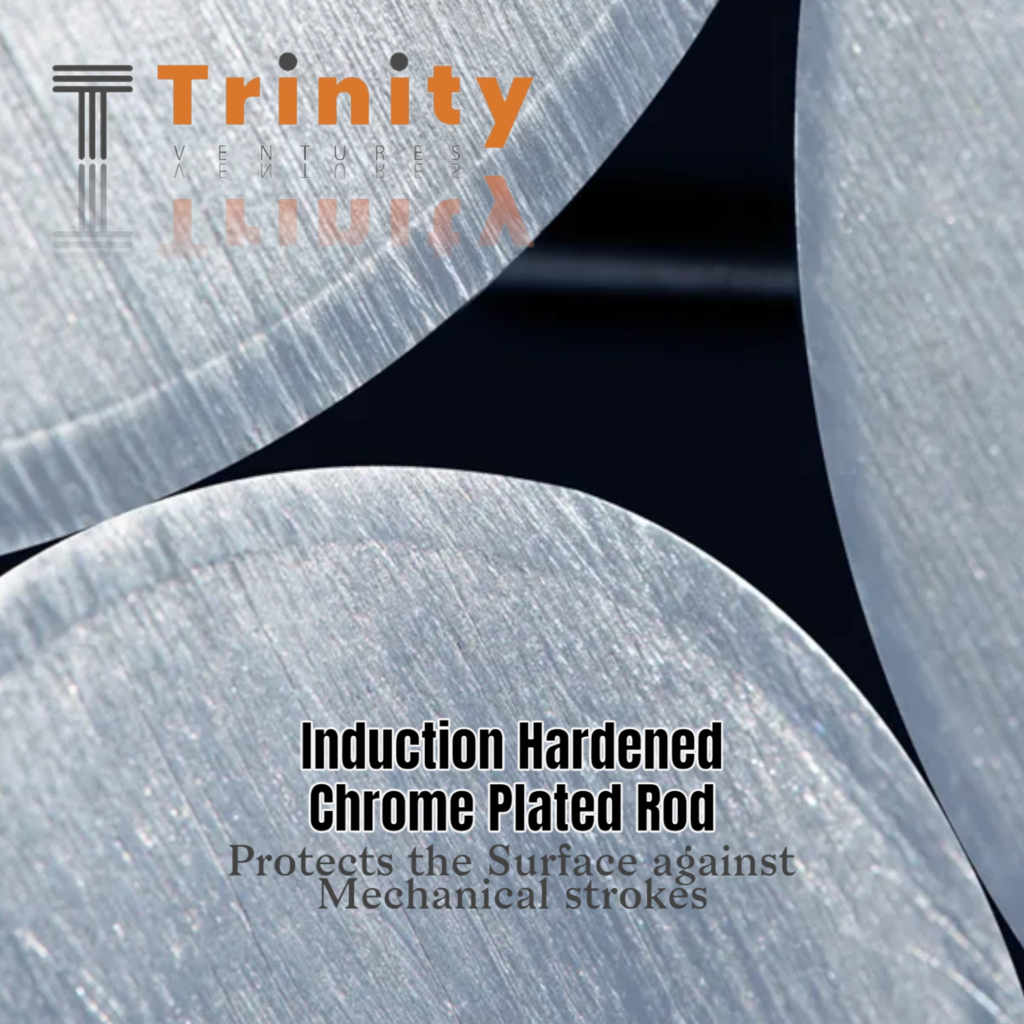
Induction hardened chrome plated round bars are high-performance components used in various industries. Here’s what you need to know:
Key Features:
- Induction Hardening: Surface hardening process that increases wear resistance and durability
- Chrome Plating: Corrosion-resistant coating that enhances surface hardness and reduces friction
- Round Bar Shape: Suitable for various applications, including piston rods and shafts
Benefits:
- High wear resistance: Withstands heavy loads and abrasive environments
- Corrosion protection: Chrome plating provides a barrier against corrosive agents
- Improved durability: Induction hardening increases surface hardness and strength
Applications:
- Hydraulic cylinders: Piston rods and shafts
- Pneumatic systems: Cylinder rods and shafts
- Industrial machinery: Shafts, axles, and other components
- Automotive: Shock absorbers, steering systems, and other components
Materials:
- Steel alloys: Common materials used for induction hardened chrome plated round bars
- Custom materials: Available upon request for specific application
Special note:
- Material: EN8D / CK45,
- Hard Chrome Plating & Hardness: 20-25 Microns Min, 850 to 1100 HV
- Hardness: 55 to 60 HRC
- Tolerance: f7,
- Ovality: 0.02mm,
- Straightness: 0.1/m
- Surface Finish: RA 0.1 to 0.4micron,
- Length up to 7500 mm as per Availability.
Leave A Comment